Category Archives: Election Profiles

  • -
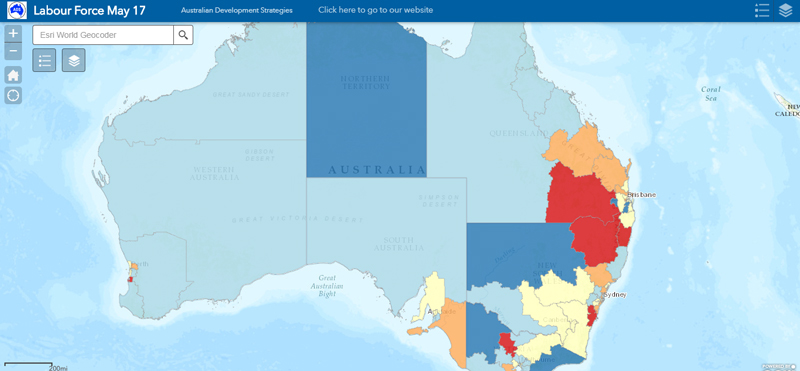
Australian Labour Force May 2017

TRADIES UP, BUT CLERKS & SALES JOBS DISAPPEAR

Category:Labour Market,Labour Market 2016,Labour Market 2017,National 2019Tags : 

The national Year on Year employment to population ratio and the participation rate stopped their downward slide during the February labour market quarter and during the May quarter both were moving in a positive direction. If we smooth the original data out to a 12-month moving average we see the start of what looks like


  • 0

CLERKS REPLACE TRADIES AS DOMINANT ALP BLOC

Category:Election Profiles,National 1966-80,National 2019Tags : 

One in four women work as professionals. Their support for Labor candidates steadily increased from 1980 under Coalition Prime Minister Malcolm Fraser and by 2004, this support had levelled off to split 50/50 between Labor and the Coalition. However, the inner-urban professional seats – such as Melbourne Ports and Brisbane – swung to Coalition Leader


  • -

DEMOGRAPHIC GUIDE TO 2016 ELECTIONS

Category:Election Profiles,Maps - Elections,National 2016Tags : 

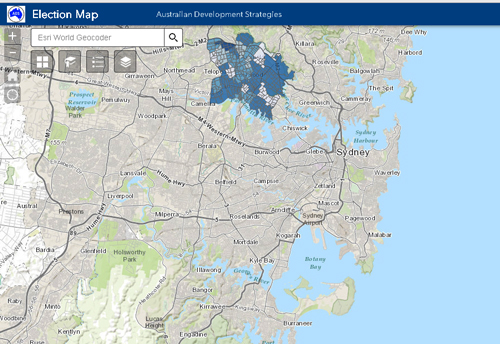
ADS, in conjunction with ESRI and Map Data Services, have produced a dashboard and linked interactive maps, to show you the key voting stereotypes for the 2016 Australian election and where you can find them. Click on the icon above for the Post Election ADS.Elect Dashboard and Maps. You will find all of the vote


  • 0
Don Dunstan

SA 1973 to 1977

Category:Election Profiles,SA 1973 to 1977

Project One – The South Australian Research This is the original research carried out by John Black while working on state and federal ALP campaigns in eastern Adelaide between 1971 and 1977. During the early part of this period, Black was a politics student at Flinders University under Neal Blewett and Dean Jaensch, who co-wrote


  • 0

AUSTRALIAN ELECTION PROFILES 1966 TO 1980

Category:Election Profiles,National 1966-80

PROJECT 1  – South Australia  1973 to 1977 PROJECT 2A, B & C – Any election you win is a good result and 1972 was no different for Gough Whitlam and the It’s Time campaign. In 1972, Whitlam was backed up by a then record spending campaign organised by his new National Campaign Director Mick Young,


  • -
1983 strategy graph map

Demographic Strategy for Historic ALP Win

Category:Election Profiles

The historic election win by Bob Hawke in 1983 set Labor up for more than a decade of reformist Governments. Hawke won the election, but the policy work had been done over the previous five years by Opposition Leader Bill Hayden and this is the associated demographic targeting strategy prepared by Bill’s then research assistant


  • 0

2015 NSW State Election Profile

Category:NSW Election 2015

The current study takes a close look at the demographic characteristics of New South Wales voters who supported Labor or the Coalition in 2015, and who swung to Labor or to the Coalition between 2011 and 2015. We also take our first look at the Greens since 2010. In this report we examine the demographic


  • 0

2015 – Qld State Election Report

Category:Election Profiles,Maps - Elections,QLD,Qld Election 2015

A week after the election on January 31, it is still unclear which of the two major parties will form a Government. The most likely outcome is a minority Labor Government supported by Independent Peter Wellington. Labor candidates won an estimated 50.9 percent of the two party preferred (2PP) vote, but Labor appears likely to


  • -

DEMOGRAPHIC PROFILE OF QLD VOTES IN 2012

Category:Election Profiles,Maps - Elections,QLD,Qld Election 2012

The strongest swings against the ALP in 2012 were from Labor’s own 2009 Labor voters. This swing correlation of minus 0.67 from Labor’s Queensland state 2009 support base was even bigger than the swing correlation of minus 0.57 against the NSW ALP from its support base last year. In other words, the biggest swings against


  • 0

2013 FEDERAL ELECTION MAP BY POSTCODE

Category:Maps - Elections,Maps By Postcodes,National 2013

Postcodes that swing to the coalition are shown in blue. Postcodes that swing to Labor are in Yellow – Red. The first range is up to 3.5% which was the national average swing, the second range is 3.5% to 7% and the highest swings are shown as 7% or more.